 Weighed at every liftMonitored 24/7One monthly price
Commercial waste collection,measured
Scheduled bin collection for businesses and buildings, run end to end by us. Sensors on every bin measure real volume and weight, so your lifts are sized to what the site actually produces. One fixed monthly price, and the platform open to you around the clock.
- Streams
- General, cardboard, commingled
- Sizes
- 240L, 660L, 1100L and larger
- Metering
- A sensor on every bin
- Billing
- One fixed monthly price
- Coverage
- Businesses across Australia
Scheduled bin collection
Front lift and rear lift services on a fixed schedule, in 240L, 660L and 1100L bins and larger. We run the service end to end, so there is one firm to call and one firm accountable for the lift.
Metered bins
A sensor on every bin reads real fill and weight between collections, not just at pickup. Lifts are sized to what the site actually produces, so bins do not overflow and you are not paying to move air.
The platform, 24/7
Your bins are monitored around the clock and the platform is open to you around the clock. Fill levels, lifts per week, weight by stream and diversion rate, per site.
One monthly invoice
A fixed monthly price, billed monthly, across every site you run. One line to approve instead of a stack of dockets to reconcile.
Four steps.
You make the call and we take it from there. Nothing is signed before you have seen the comparison.
A short call.
Who you are with now, and roughly what you pay. Ten minutes is usually enough.
No quote over the phone.
The comparison.
We price your current setup against ours, line by line, and show you both. If you are better off where you are, we will say so.
Yours to take to procurement.
Bins and sensors in.
Bins are delivered, sensors fitted, and the service starts on the agreed date.
One firm accountable for the lift.
Reporting from day one.
The platform is live from the first collection. Fill, lifts, weight by stream and diversion, per site.
Monthly reporting, no waiting period.
Four kinds of site.
The work is the same whichever one you are: measure what the site actually produces, size the service to it, and report it in a form that holds up.
Your bins, on a screen.
Open to you around the clock, not a monthly PDF. Everything here is read from the sensors on your bins.
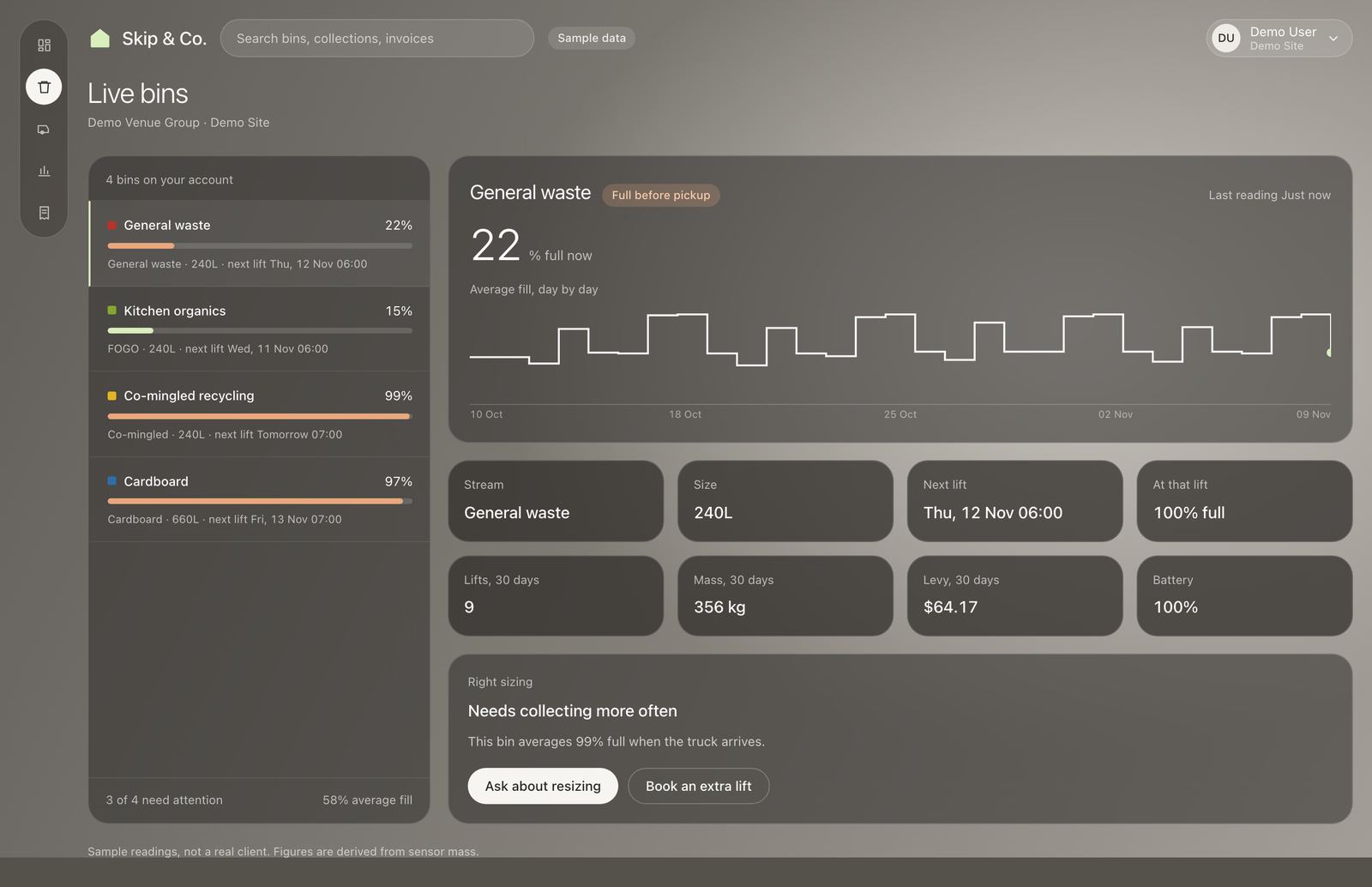
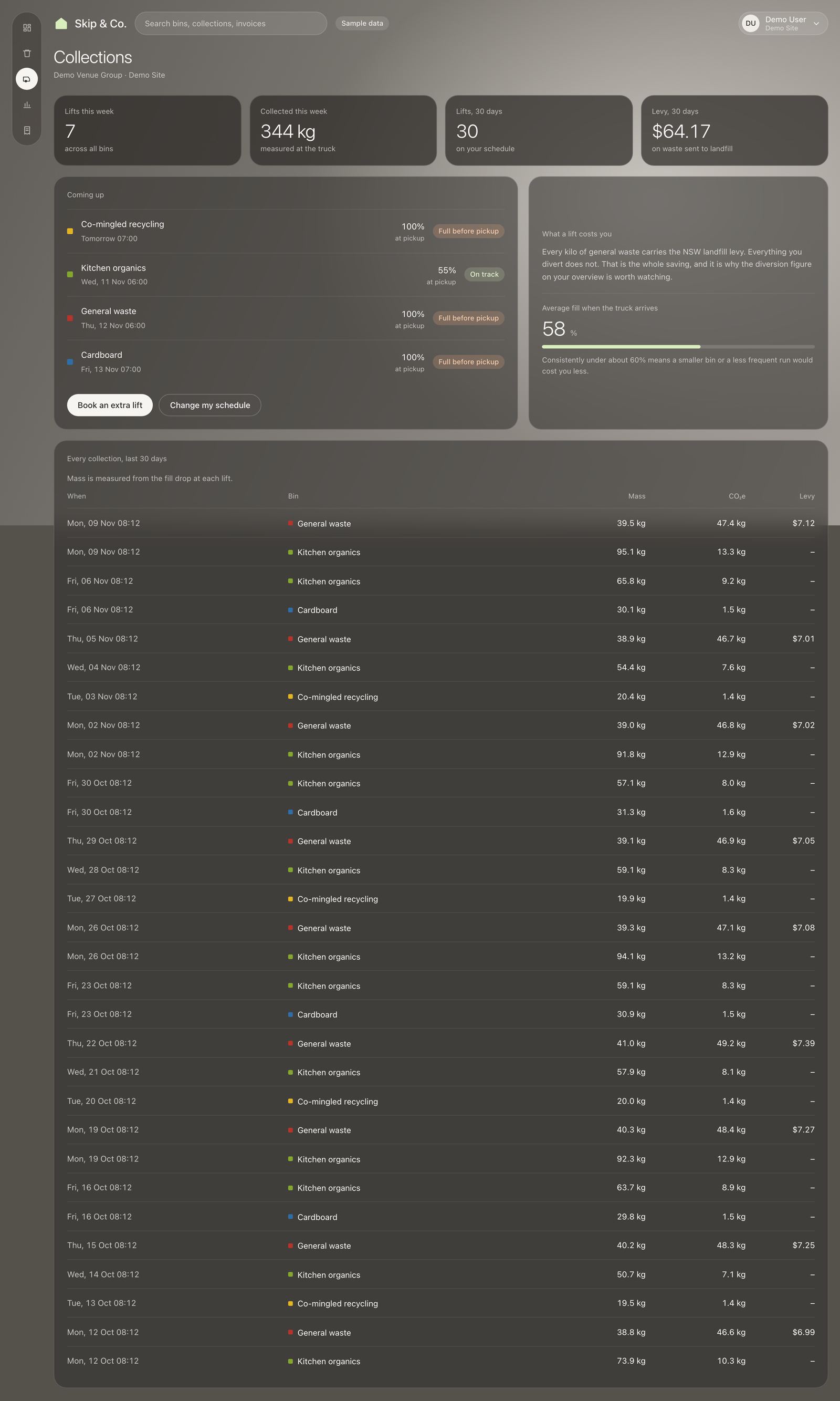
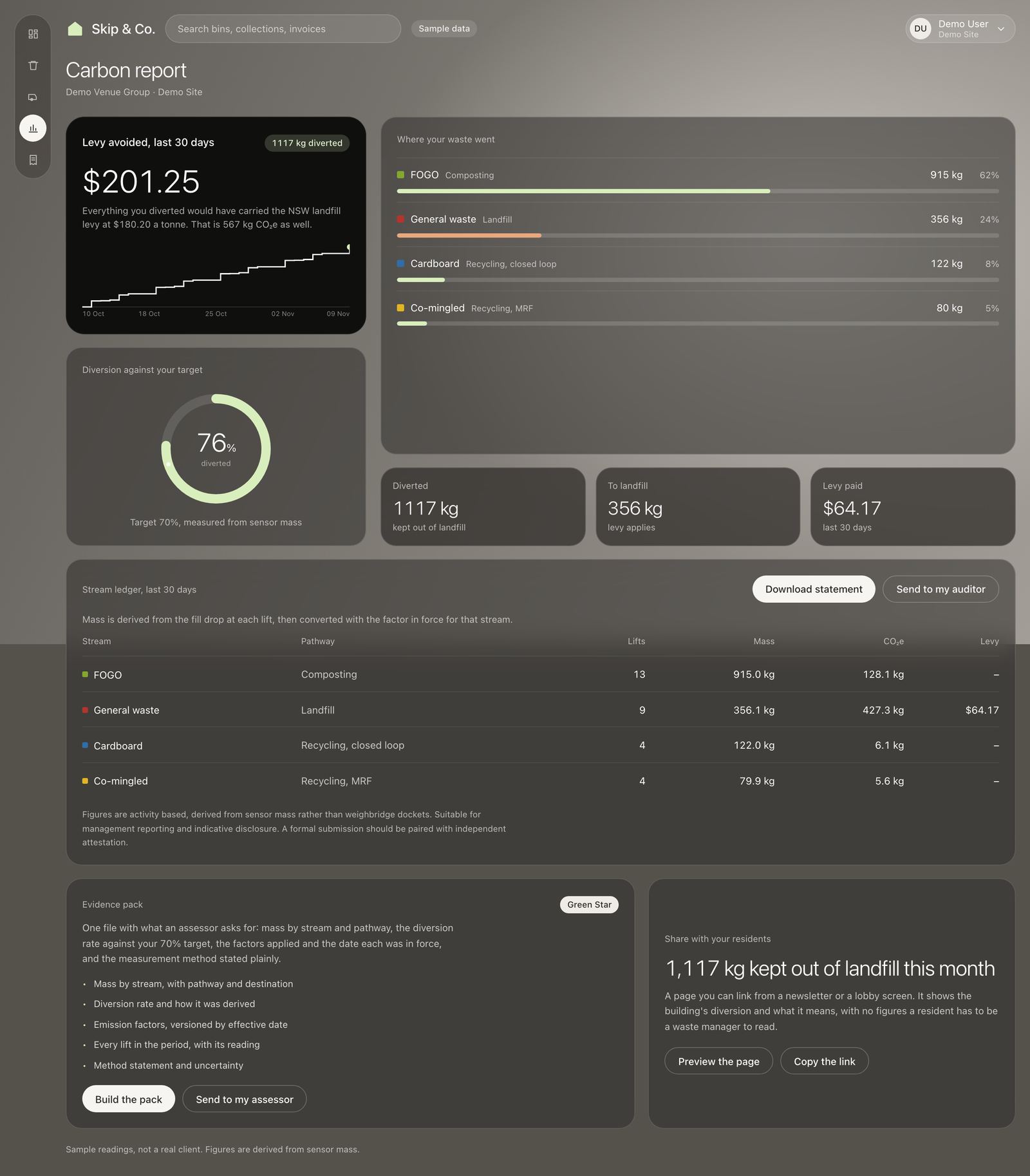
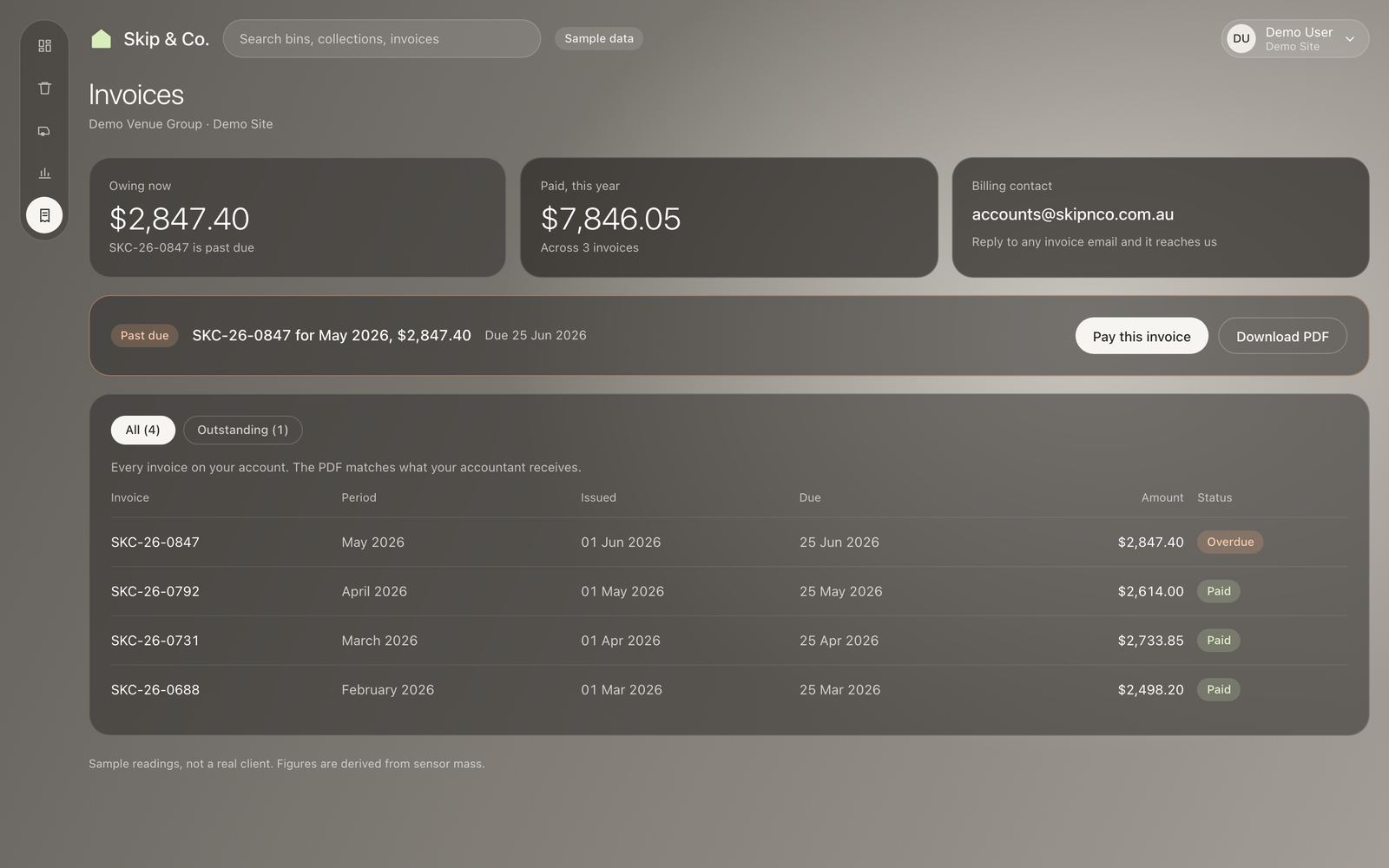
Fill level now, the next lift, and whether the bin is the right size.
- Fill level, bin by bin
- Lifts per week, against what you are paying for
- Weight by stream
- Diversion rate
- Site against site, for multi-site groups
If we miss our SLA, you can leave.
The service level sits in the agreement, and so does the exit. Miss it and you can walk with no break fee. We would rather carry that risk than ask you to take the service on trust.
The bins, and what they actually hold
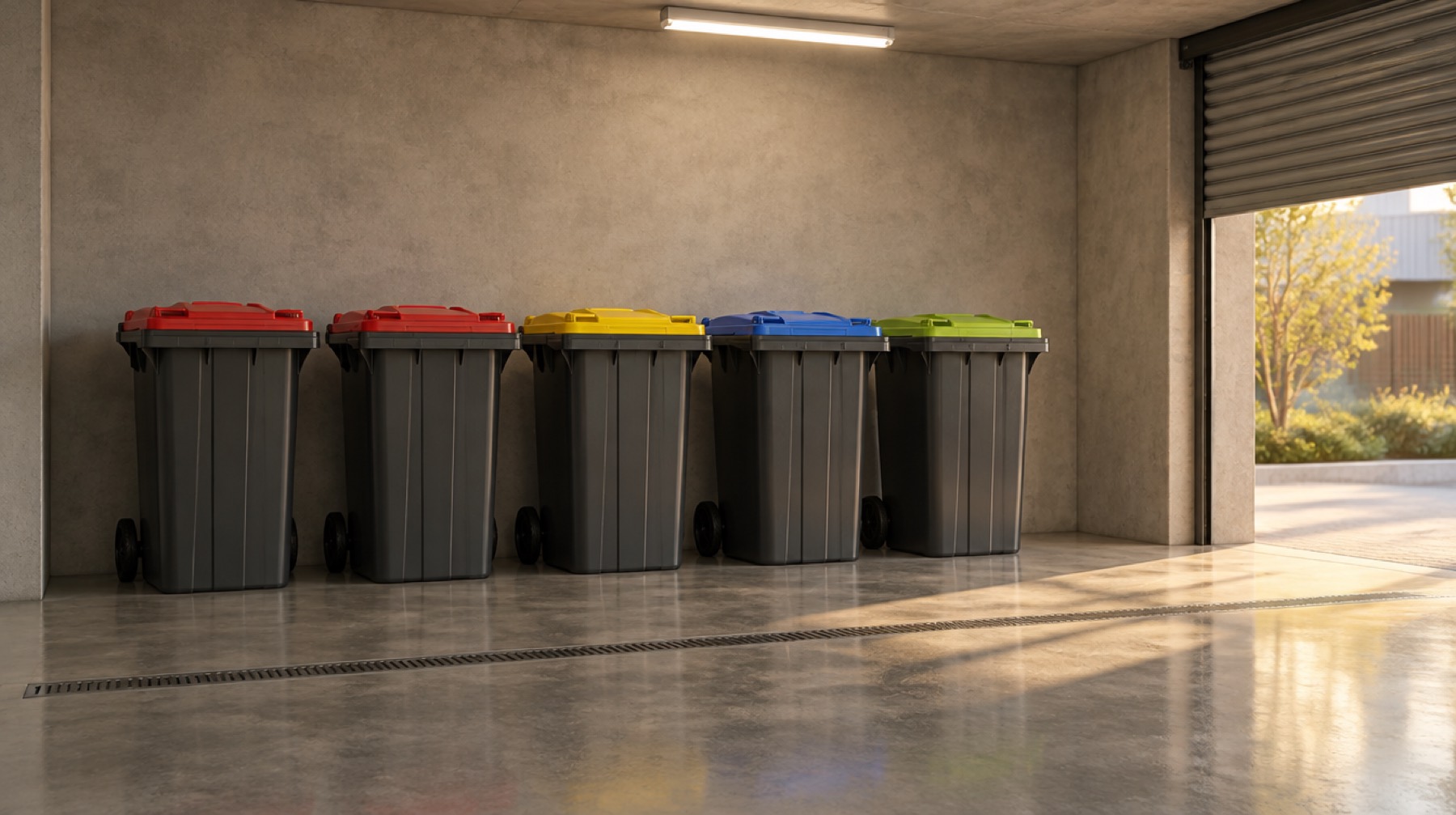
Lid colours follow AS 4123.7, so a bin bay reads the same whoever services it. Sizes are the real article: a 240 litre two-wheeler takes about 43 kg of general waste, an 1100 litre bulk bin nearly five times that. Getting the size wrong is the most common thing we find on an invoice, and it is what the sensors are there to stop.
| Size | Stream | Dimensions, W × D × H | Wheels | Holds | |
|---|---|---|---|---|---|
| 240L | General | 580 × 740 × 1070mm | 2 | 43kg | The standard commercial bin |
| 240L | Commingled | 580 × 740 × 1070mm | 2 | 22kg | Bottles, cans, rigid plastics |
| 240L | Cardboard | 580 × 740 × 1070mm | 2 | 12kg | Flattened boxes only |
| 660L | Organics | 1370 × 780 × 1200mm | 4 | 277kg | Kitchen organics, heaviest stream |
| 1100L | General | 1370 × 1070 × 1470mm | 4 | 198kg | Loading dock, multi-tenant |
Holds is volume times the density that stream actually packs at, not the bin's rated capacity. It is why a full cardboard bin weighs a fifth of a full organics bin the same size.
Where it goes after the truck
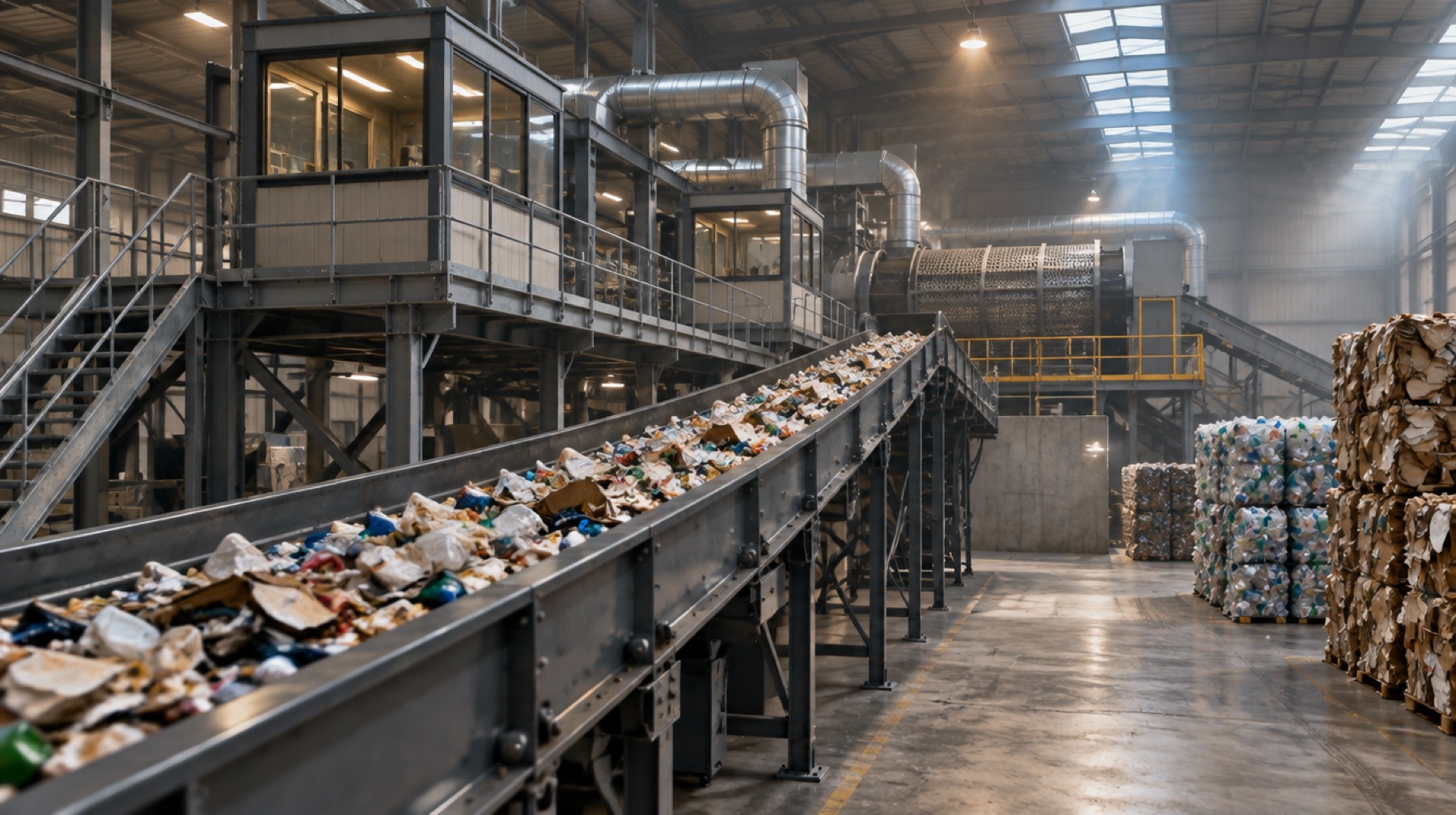
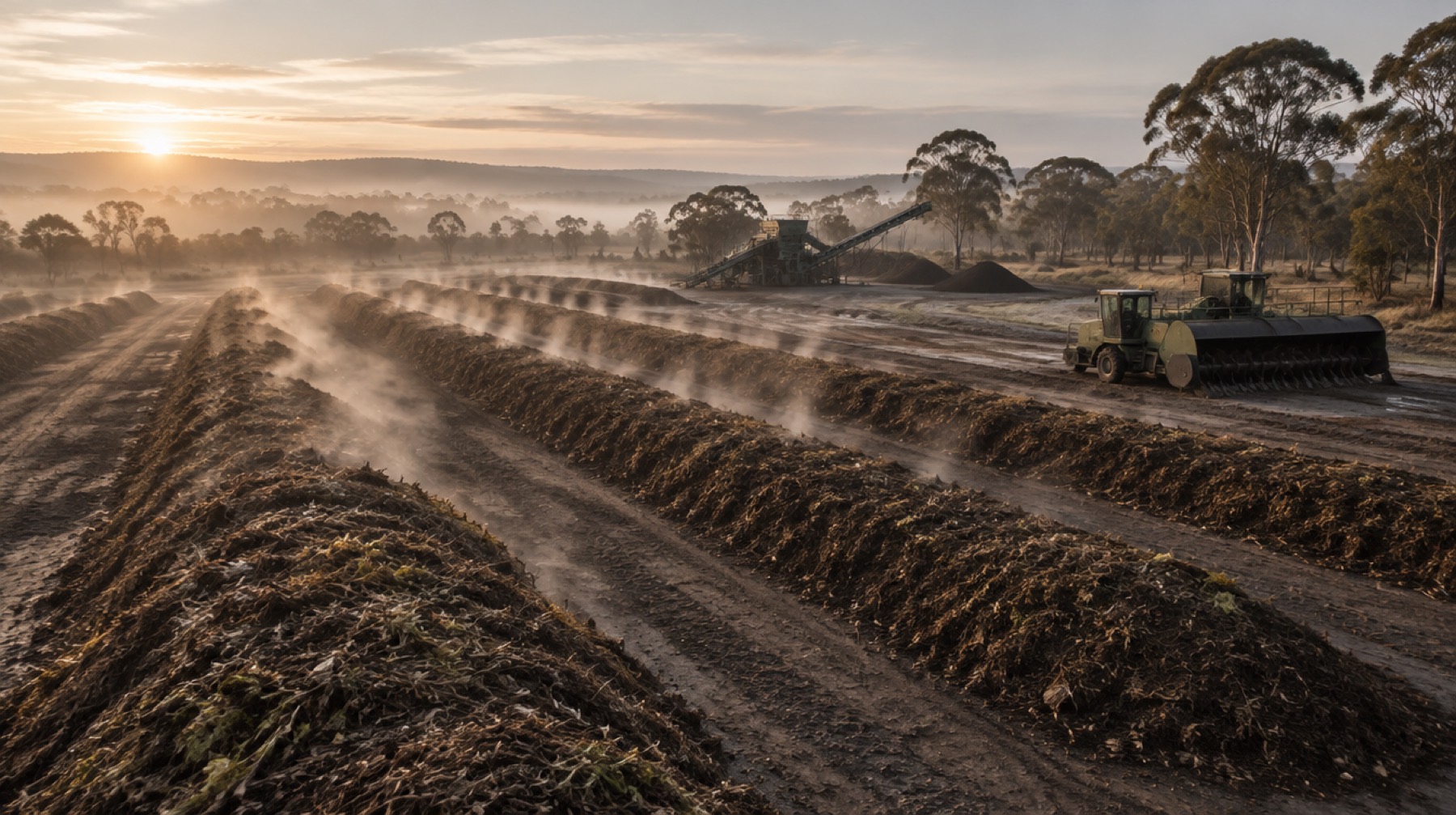
Diversion is not a target you set, it is a consequence of what ends up in which bin. One bagged or food-fouled load and the whole bin is charged as general waste, which is why the training and the signage matter more than the contract.
- General wasteRed lid0.18kg/LGoes toLandfillCarries the levyWhat ruins it
Nothing ruins it. Everything in it carries the levy.
- Food organicsLime green lid0.42kg/LGoes toComposting, or anaerobic digestionNo levyWhat ruins it
Plastic bags, including compostable ones that are not certified AS 4736.
- Commingled recyclingYellow lid0.09kg/LGoes toMaterials recovery facilityNo levyWhat ruins it
Anything inside a bag. Soft plastics. Food and liquid.
- Paper and cardboardBlue lid0.05kg/LGoes toRecycling, closed loopNo levyWhat ruins it
Grease and damp. A wet load goes to landfill.
Built to be checked.
- NGA factors
- Emissions are calculated on the Australian National Greenhouse Accounts factors, not a figure of our own.
- Scope 3, Category 5
- Waste generated in operations, at end of life, structured for AASB S2 climate disclosure.
- Diversion records
- What left the site, which stream it went out in, and where it went. Kept per site and per month.
We built this around measurement, not the truck.
Most waste contracts are written around the truck. A set number of lifts, a set day, and nobody checks whether the bin was full. I spent long enough on the other side of that invoice to know how much of it is guesswork.
So we built Skip & Co the other way round. Put a sensor on the bin, measure what the site actually produces, and size the service to that. It is not a clever idea. It is just the obvious one, and the industry has not been in a hurry to adopt it.
We are a newer operator. I would rather tell you that than have you find out. What I can offer is that every number you get from us comes off a sensor or an invoice, the price is fixed and billed monthly, and if we miss the service level you can leave without a break fee.
If you want to know what you are actually paying for waste right now, that is a ten minute call and I will give you the comparison either way.
Measuring a bin changes what goes into it.
We are a newer operator without a client study to show you yet. What we can show you is the largest published test of the thing we do. The NSW EPA ran a programme called Bin Trim that assessed businesses' bins and tracked what happened next.
Bin Trim assessed a site once. Every bin we run is measured at every lift, which is the same idea applied continuously rather than on a visit. That is the whole argument, and the figures above are somebody else's, not ours.
Bin Trim is administered by the NSW Environment Protection Authority. Bin Trim is a NSW Government programme, not a Skip & Co one. It is cited here because it is the largest published test of the idea this business is built on.
The first one is being written.
We are not going to put a client's numbers on this page before they have read them and agreed. When the first study is approved it will appear here, with the figures and the method behind them.
Ask us anything.
Everything we get asked, answered properly. Type a question and it will find the closest one.
25 answers
Tell us what youpay now.
We will price your current setup against ours and send you both, line by line. If you are better off where you are, we will tell you. Reply within one business day.
- Direct
- contact@skipnco.com.au
- Coverage
- Servicing businesses across Australia